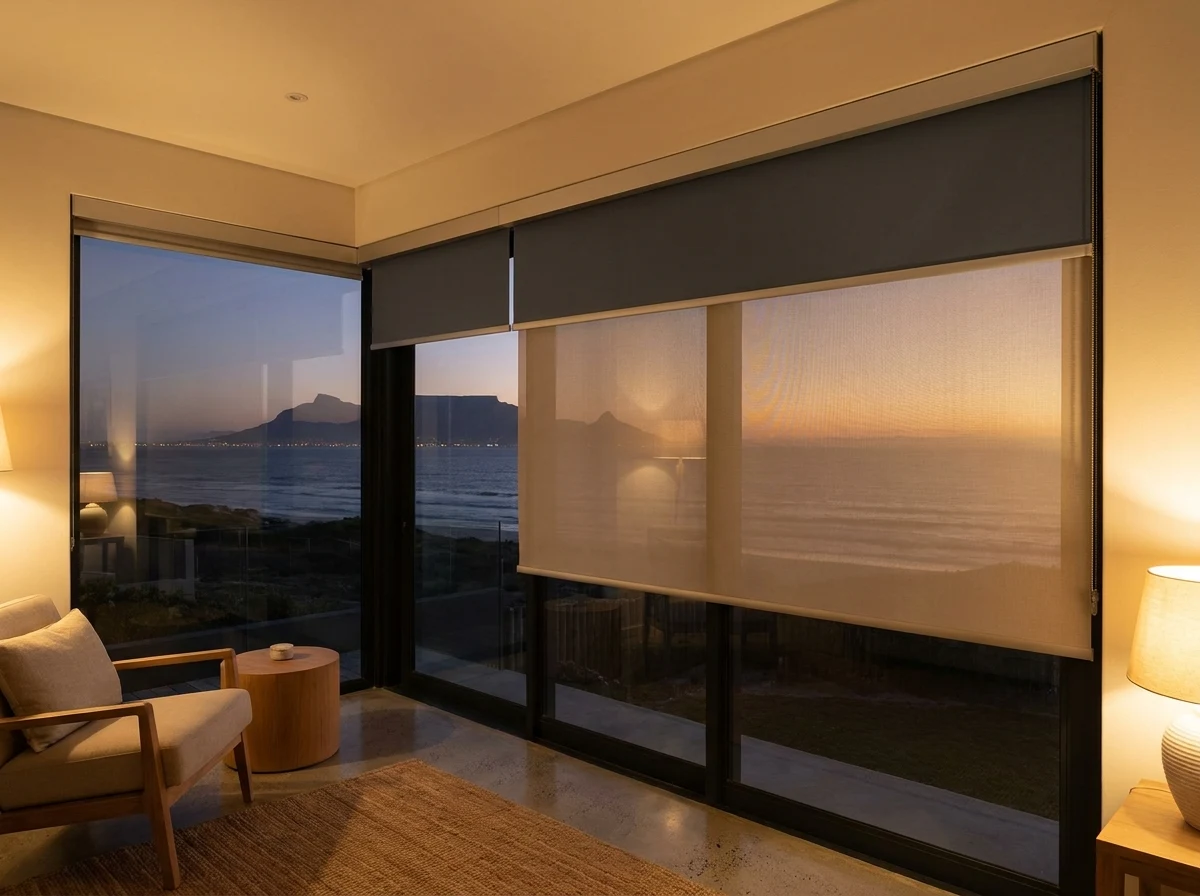
Flat sunscreen roller blind drawn across a floor-to-ceiling window in a Sunset Beach lounge, Table Mountain standing across Table Bay behind the mesh

Home / The Guide

The House With Two Fronts

Free and sourced. In Sunset Beach the wall that gets the sun and the wall that gets the view are on opposite sides of the building — and almost every shading mistake made here comes from treating them as the same problem.

This guide is also a PDF you can download and read offline (15 pages).

Free · no obligation · nothing to fill in

A Sunset Beach house is usually freestanding, usually single or double storey, and usually built with glass on at least two elevations — one opening onto a north-facing garden and pool, the other pointed across the water toward Table Mountain and Robben Island.1 Those two elevations want opposite things, at opposite times of year. Everything below follows from that.

One

Two fronts, one building

Sunset Beach sits on the northern shore of Table Bay, at the seaward edge of Milnerton, with the Milnerton lagoon, Woodbridge Island and the Rietvlei reserve immediately behind it and Sunset Links alongside.1 It is a suburb of freestanding homes rather than blocks, and the property descriptions for it keep repeating the same two features in the same sentence: north-facing gardens with sheltered pools, and views of Table Mountain and Robben Island.1

Read that as an architect would and you have the whole brief. In the southern hemisphere north is the equator side, so a north-facing garden is the warm, bright, all-year one — that is why it is sold as a feature. Table Mountain, meanwhile, is across the water to the south of here, and Robben Island lies off to the west.2 The sun and the view are not merely on different walls. They are on roughly opposite walls.

In an older cottage that would hardly matter, because the openings would be small. In the kind of house Sunset Beach is actually made of — open plan, glass on two or three sides, the living space running through the middle — it matters a great deal, because one room is looking out of both fronts at once and a single decision about fabric has to serve them both. It usually cannot.

The sunny wall and the view wall are not neighbours here. They are on opposite sides of the house, and they peak in opposite seasons.

The whole argument of this guide
Two

The north front

North glass takes sun every day of the year, and the shape of that sun changes completely between seasons. Sunset Beach lies at about 33.85° south; from that latitude and the earth's 23.4° tilt, the December noon sun stands roughly 80° above the horizon and the June noon sun manages only about 33°, due north.3

Those two numbers are the argument for and against every product on this wall. At 80° a modest eave, a first-floor balcony or a pergola genuinely shades the glass below it — the sun is almost straight down. At 33° the same eave does nothing at all, and the light travels several metres into the room, warming the floor and the furniture. That low winter sun is not a problem to be solved; on a Cape winter afternoon it is free heat that a north-facing house was designed to collect.

Which is why over-specifying here is a real and common mistake. Fit a heavy blockout to the north wall to solve four weeks of January and you have also thrown away three months of June, and you will find yourself running a heater in a room that used to warm itself.

What belongs on the north front is something adjustable, hour by hour:

  • Tiltable slats. An aluminium venetian lets you bounce the light up off the ceiling rather than down onto a desk, and closes when you want it closed. This is the classic answer for a north study or a kitchen.
  • Sunscreen mesh you can set anywhere. Lower it to the height that kills the glare and leave the rest of the glass open. On a garden-facing window, being able to still see the pool matters.
  • External venetians, where the heat rather than the light is the complaint. On a north wall with a lot of glass and no overhang, stopping the energy outside the pane is the only intervention that changes the room temperature rather than merely the brightness.

Bottom-up cellular blinds deserve a mention here too. They shade the lower half of the window and leave the top open, which on a north wall means privacy from the garden path while the winter sun still comes over the top of the fabric and lands where you want it.

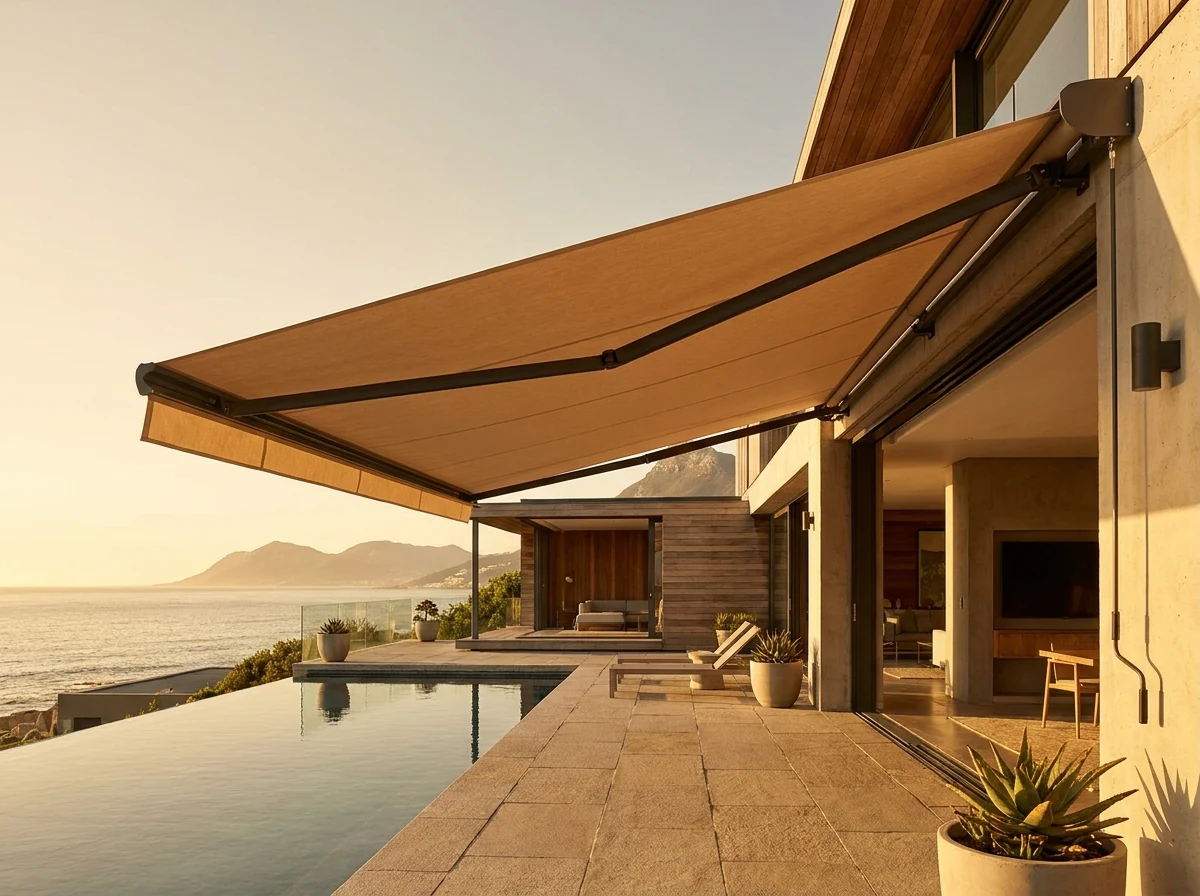
Retractable folding-arm awning wound out over a poolside terrace at a Sunset Beach home, the ocean visible past the far edge of the pool
Retractable shade over the pool terrace — run out through the worst of summer, wound away when the June sun is something you want back on the paving.
Three

The sea front

The other elevation has the opposite temperament. It is comfortable for most of the middle of the day and difficult at the end of it, and the difficulty is entirely about angle.

Worked from the same latitude: in midsummer the sun sets about 28° south of due west, and in midwinter about 29° north of due west.3 So through the height of summer the last hour and a half of daylight comes in from the seaward quarter, low, and roughly along the axis your best glass is pointed. Nothing above the window intercepts light arriving at that angle — an overhang shades what is above it, and this is coming in almost horizontally.

Two further things make the sea front harder than a west-facing wall inland. The water in front of it reflects a broad sheet of that low light back toward the shore, so the room is lit from the sky and from the bay at the same time. And there is no building across the road to intercept any of it.

Why we lead with external shading on this wall

Once light has crossed the glass it has become heat inside the room. An interior blind then absorbs it and radiates a share of that heat back inward — excellent for glare, only partial for temperature. Anything mounted outside stops the energy before the pane ever warms, which is why on this elevation the external range is our first recommendation rather than the last line of the quote:

The aimable one

External venetian blinds

Wide aluminium slats outside the glass that tilt through the day. Set them against the low sun and you can still see the water underneath them, which is the entire point on a wall whose job is the view.

Honest limit: more exposed to wind than the alternatives, because the slats present a large surface. It wants a wind sensor and a sensible aspect.

The robust one

Roller shutters

Rigid interlocking slats running in a fixed guide rail either side. Nothing loose for the wind to lift, complete shading when closed, and genuine dark for a room that also has to sleep.

Honest limit: closed is closed — it does not do partial view. And it is a shading product here, not a security-rated one. We say that plainly rather than let it be assumed.

The room-maker

Zip screens

A mesh whose edges run inside aluminium channels on a continuous zip, so there is no free hem for the wind to work at. It is what turns an unusable seaward deck into a room you can actually eat in, with the horizon still legible through the weave.

Honest limit: it is a screen, not a wall. In driving rain from the front you will still feel it.

The one that vanishes

Folding-arm awnings

The right product where you want the shade gone entirely for eight months of the year — over a north terrace, or a seaward deck with something upwind of it.

Honest limit: an extended arm has nothing anchoring its outer edge. On a fully exposed seaward corner it is the most vulnerable of the four.

Behind whichever of those is chosen, the interior blind still has work to do — a low-openness sunscreen mesh for the daytime glare, and something opaque for the night-time problem in section five.

Aluminium external venetian blinds mounted outside the ocean-facing glass of a Sunset Beach house, evening light on the slats
Slats outside the glass. Tilted against the last of the sun, they hold the heat off the pane while the water stays visible beneath them.
Four

The corner where they meet

Wrap-around and corner glazing is common in this suburb, and it is where the two fronts stop being separate conversations. One structural corner, two elevations, and a single continuous fabric run that somebody has to specify.

Three practical rules we work to:

  1. Specify by elevation, not by room. A corner lounge is not one window. Different fabric, or at least a different openness, on each leg of the corner is normal here and it is not untidy — it is the reason the room works at both ends of the day.
  2. Keep one fabric family across the whole house. Vary the openness and the operation; do not vary the colour and the texture window by window. Seen from the garden, a house should read as one decision.
  3. Watch the meeting point. Two blinds arriving at an internal corner leave a gap unless the brackets are set out for it. That is a measure-day detail and it is exactly the sort of thing that is expensive to discover after manufacture.

On very wide unbroken spans — and a Sunset Beach living room often has four metres or more in one run — a single chain controlling that much fabric is something you will come to resent. We would split the opening or link it under one motor, and say so before anything is cut.

Double roller blind carrying a blockout layer behind a sunscreen layer on one bracket over a corner window in a Sunset Beach lounge, Table Mountain visible through the mesh
Two fabrics on one bracket at a corner window — mesh for the afternoon, blockout behind it for after dark.
Five

Day against night

Sunscreen mesh has one property that is almost never explained at the point of sale, and it causes more disappointment than any other single thing in this trade: it gives daytime privacy only. The effect depends entirely on which side is brighter. During the day the outside is brighter, so you can see out and nobody can see in. After sunset, with the lamps on, the relationship inverts — and a house on this beachfront is then a lit stage seen from a public path.

There is no fabric that solves both with one layer. There are three honest ways round it:

  • A double roller. Mesh in front, blockout behind, on a single bracket. One product, two behaviours, no swapping anything by hand.
  • Banded day-night fabric. Alternating sheer and solid stripes on one tube: slide them into line and the window closes down; offset them and it opens up. Lighter and cheaper than a double roller, though a shade less absolute at the fully closed end.
  • Bottom-up operation. Where the concern is somebody walking past rather than the whole window, raising a cellular blind from the sill upward covers the eye-level band and leaves the sky and the view above it.

And in the bedrooms

Darkness is a fitting question, not a fabric one. All blockout cloth is opaque; what reaches you at five in the morning came round the perimeter rather than through the weave. There are three ways to buy it and they are not the same price. Inside the reveal is the tidiest and leaves a bright hairline down each edge. Across the front of the opening is considerably darker and hides the joinery. Inside the reveal with side channels closes the perimeter properly and adds a component. Tell the consultant which of the three you are actually buying, and the number stops being mysterious.

Flat blockout roller blind run fully down over a main bedroom window in a Sunset Beach house
Blockout in a main bedroom. Whether it is genuinely dark at five in the morning is decided by how it is fitted, not by which fabric is on the tube.
Six

Open against closed

From about October the south-easter settles onto this coast for the summer, at its most relentless through November and December.4 Anything you hang outside has to live in it, and it is worth understanding what actually fails, because it is not usually the thing people expect.

An extended awning is a large fabric surface held out on two arms. In moving air it does not simply get pushed — it behaves a little like a sail, and the load ends up concentrated at the arms and at the wall fixings. That is why a wind-damaged awning is far more often a bent arm or a pulled bracket than a torn fabric, and it is why the answer is never a heavier cloth. The answer is either to remove the free edge, or to remove the awning before the wind arrives.

So the decision reduces to one question: can this product's edges be held? A zip screen's are, in its channels. A roller shutter's are, in its guide rails. An awning's are not, by design — which is a fine trade on a sheltered north terrace and a poor one on an exposed seaward corner. Where an awning is still the right product, an anemometer wired to the motor is what makes it survive, because the wind here builds through the afternoon while the house is often empty.

Salt, honestly

Salt in the air is not simply dirt. It pulls water out of the atmosphere and keeps a thin conductive film on bare metal, and that film is what corrodes an unprotected fitting. Marine-grade powder-coated aluminium and stainless fixings are therefore not a finish upgrade — the coating is the entire defence, so a scratch through it matters more than a mark on the fabric. Ten minutes with a hosepipe, twice a year, on anything outside the glass: that really is the whole schedule, and it is worth the ten minutes. Anyone describing a product on this coastline as maintenance-free is selling rather than specifying.

Outdoor zip screen in sunscreen mesh closing off a wind-exposed balcony at a Sunset Beach apartment
Edges captive in the channel. That, rather than the weight of the fabric, is what keeps a screen usable on an exposed elevation.
Seven

What the site visit is actually for

Every paragraph above was written from geometry. The next five are physical, and they are why nobody should quote a house from a photograph:

  1. The true bearing of each elevation. Plots here are not all square to the street, and a house turned twenty degrees changes which wall is the sea front and which is the sun front. Everything in sections two and three depends on it.
  2. Reveal depth at three points on every opening. Fifteen millimetres is the difference between a headbox tucked into the frame and one standing off the wall, and it is also what makes side channels possible or impossible.
  3. What the wall is built up from. Masonry, cavity, or a light infill panel between structural columns. The build-up determines the anchor, and occasionally rules an exterior system out on that elevation.
  4. How exposed your specific corner is. A deck tucked behind the house and one on the open seaward corner are not the same brief in a south-easter, and that comparison — not a catalogue — chooses between an awning and a zip screen.
  5. Where the power is. Whether there is a circuit near the head of the opening, and whether a cable can still be pulled without opening a ceiling that has already been painted.

A visit answers all five in about forty minutes. That is cheaper for us than remaking a blind, which is why it is free to you.

Get this applied to your own two fronts

One visit, both elevations walked with a compass, every opening measured, and an itemised quote in writing afterwards. Nothing is charged and nothing is assumed.

Book a free in-home measure→
Get in touch

Tell us which front is the problem

Say which rooms and which elevation is giving you trouble, and one of our expert consultants will contact you shortly to arrange your free in-home measure.

  • No obligation, no call-centre — a consultant calls you directly
  • Fabric and marine-grade hardware samples brought to the measure
  • Written, itemised quote before anything is ordered

Your details are used only to arrange your consultation call-back and are never shared beyond that, in line with our Privacy Policy (POPIA).

Working out

The references behind this

Every geographic and climate claim above traces to one of these. Where something was calculated rather than quoted, it says so.

  1. Seeff Property Group — Sunset Beach area profile: Sunset Beach and Sunset Links as up-market estates in Milnerton on the northern stretch of Table Bay; views of Table Mountain and Robben Island; freestanding houses; and properties described as having north-facing gardens with sheltered pools. Milnerton lagoon, Woodbridge Island and the Rietvlei reserve as immediate neighbours. seeff.com — Sunset Beach
  2. Position of Table Mountain and Robben Island relative to this shoreline. Table Mountain lies across Table Bay to the south of the northern shoreline suburbs; Robben Island lies off that shoreline to the west. Taken from the published coordinates of each rather than from any local measurement of ours. en.wikipedia.org — the Table Bay northern shore
  3. Solar geometry — calculated, not cited. Sections two and three rest on four angles, all of them arithmetic: noon altitudes of roughly 80° and 33° at the two solstices, and sunsets falling about 28° south and 29° north of due west. They follow from 33.85° S and a 23.4° axial tilt, and no local instrument was involved.
  4. The Cape Doctor — the summer south-easterly, present on this coast from about October to March and at its worst around November and December. capetownmagazine.com/cape-doctor
  5. Where wind load ends up on a retractable awning, and the hygroscopic behaviour of airborne salt on unprotected metal, are general engineering and materials principles rather than local measurements. We have described the mechanisms and left figures out, because we have not measured either on this beach.

Which product we would put where is an opinion, freely given and not conditional on your buying anything. Estate and municipal approvals are not ours to grant, and we do not describe them as certainties.

Take the PDF — the same 15 pages, yours to keep.