Trapped air against a wind that doesn't let up
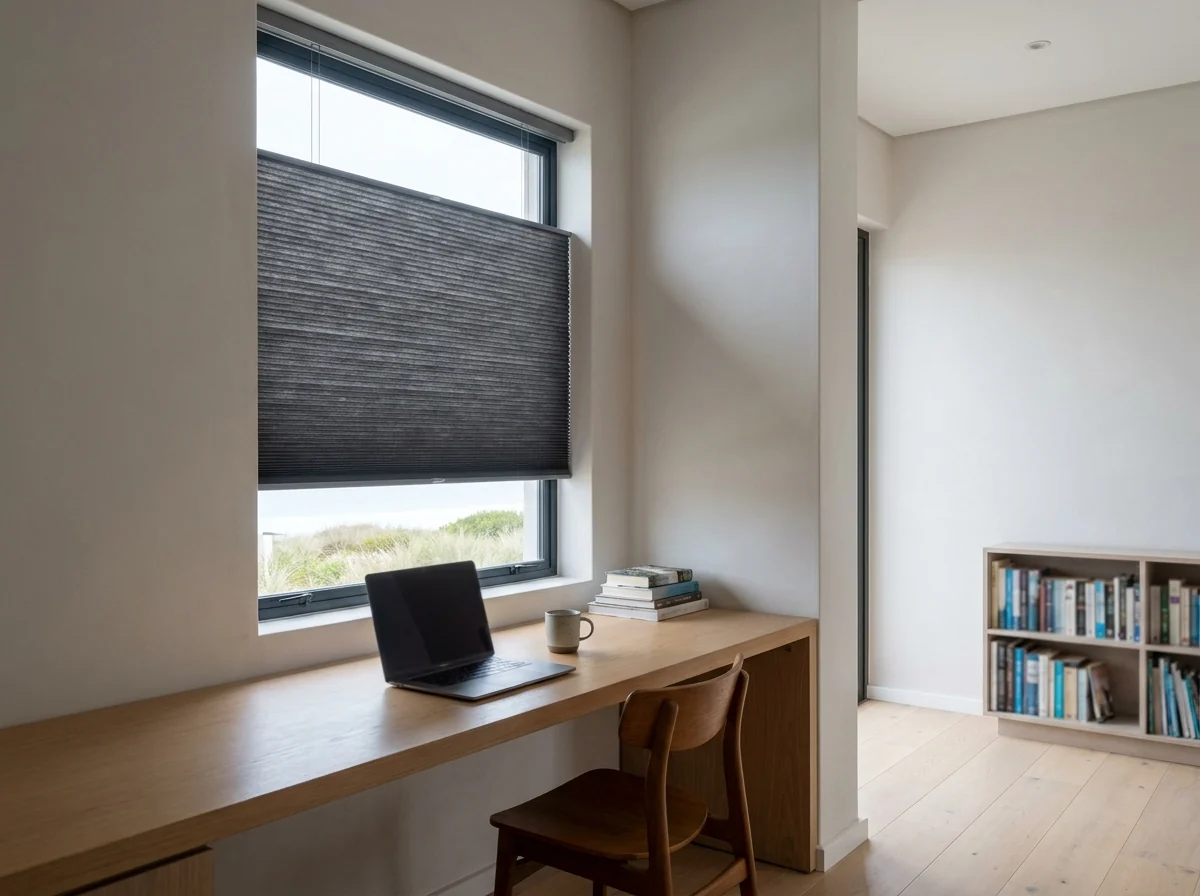
A honeycomb blind's whole trick is a hexagonal air cell holding a layer of still air against the glass — genuinely useful insulation in either direction, hot or cold. On a stretch of coast that takes the summer south-easter and winter storm fronts as a matter of course rather than the exception, that still-air buffer does real work against a room that would otherwise track the wind chill outside more closely than the thermostat inside.
Top-down, bottom-up — the beach-path answer
Corner bedrooms overlooking the coastline here usually face the same complication: the view is worth keeping, but so is not being visible to anyone walking the beach path below. A top-down/bottom-up cellular blind solves both at once — lower the top of the blind for sky and light with the bottom still covering eye level, or drop it fully for a bedroom that wants proper dark. It's the version of this product we fit most often on corner glazing here.
Where it earns its keep in a Sunset Beach house
Bedrooms and nurseries are the obvious fit — dark, quiet and insulated in one product — but a home study or second bedroom with a single large pane benefits just as much, especially on the upper floor of a double-storey house where wind noise carries more. Light-filtering or full blockout cell fabric, cordless or motorised operation, and a skylight version for the raked gable glass a lot of these houses bring in over a stairwell. Both of those briefs turn up away from Sunset Beach too. In a Sunningdale family home it's the blockout cell fabric on an ordinary bedroom window, and it goes up child-safe with no cord hanging where a toddler can reach it. Further up the coast at Melkbosstrand, where a house can sit closed between visits, it's the insulating side that gets noticed — the cell holds its layer of still air with nobody there to do a thing about it, so the room isn't starting from whatever the weather did while the family was away.
The rooms that ask for a honeycomb blind here aren't the ones with the worst sun — they're the ones with the worst wind noise on a July night.
On-site measure, Sunset Beach- Single or double-cell fabric, light-filtering or full blockout
- Top-down/bottom-up for corner windows overlooking the coastline
- Cordless or motorised operation, slim stack when raised
- Guided skylight version for raked gable glass over a stairwell
Cellular blind pricing on this coast
A honeycomb blind contains more cloth and more assembly work than a single sheet, and the figures follow: R1,500 to R2,800 per square metre installed hand-operated, single-cell fabrics low in that band and double-cell or blockout-lined fabrics at its top end. Motorised, allow R3,000 to R4,800 per square metre. On a west-facing pane that bakes all afternoon, the insulating cell is the reason to choose one at all.
These are guide bands, not a quotation. Small windows carry a minimum charge, since the hardware and the fitting labour barely reduce with the opening. Each window is worked out on its own at the measure and confirmed in writing.
Corner windows catching the wind?
Nothing to pay for the measure, a written figure against every window, and no obligation at the end of it.